Stray Dog Menace Suo Motu Case: Supreme Court refuses urgent hearing on MCD stray dog rules, says ‘we will play a video’ to decide what humanity means
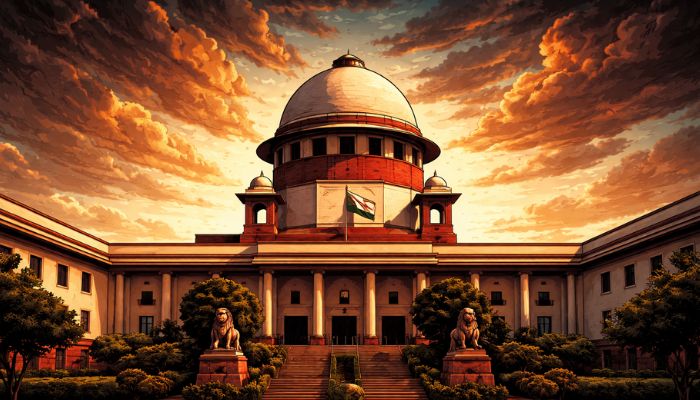
Supreme Court of India (Image: Dall-E)
On 18th December, the Supreme Court of India firmly declined to grant an urgent hearing against the Municipal Corporation of Delhi’s newly framed rules on handling stray dogs. The apex court made it clear that it would not rush into intervening in the suo motu case on the stray dog menace. Notably, the three judge bench hearing the matter was scheduled to take up the case on Thursday, but the date was postponed to 7th January 2026 on Wednesday evening.
The matter was mentioned by Senior Advocate Kapil Sibal before the Bench of Justices Vikram Nath and Sandeep Mehta. The Bench, however, rejected the plea for urgent interference, indicating that the issue would be examined in detail on the next date of hearing.
Kapil Sibal calls removal of stray dogs “very, very inhuman” while mentioning MCD Rules.
— Anurag (@LekhakAnurag) December 18, 2025
Supreme Court’s response is sharp and clear: "on the next date, we will play a video and ask you what humanity really means."#StrayDogMenace #StrayDogFreeIndia pic.twitter.com/6MDHd1hkRN
When Sibal objected to the MCD rules as being “inhuman” and contrary to statutory safeguards, the Court remained unmoved. Justice Nath made it clear that the matter would now be taken up on 7th January, and not earlier, despite claims of urgency.
‘Let them do it, we will consider,’ says Court
Sibal informed the Bench that the three judge bench scheduled to hear the matter on Thursday had been cancelled. He pressed for an early hearing and argued that the MCD was likely to implement the rules in December itself, which include the removal of stray dogs, even though, according to him, adequate shelters are not available.
“They don’t even have shelters. What is being done is very, very inhuman,” Sibal submitted, seeking immediate judicial intervention.
However, the Bench refused to halt the process. Justice Nath responded bluntly, saying, “It is alright, Mr Sibal. Let them do it, we will consider.” Justice Mehta went a step further, remarking that on the next date, the Court would “play a video” and ask the petitioners what humanity actually means.
Sibal countered that the petitioners too would present videos to demonstrate ground realities and claimed violations of statutory rules and previous court directions. The Court nonetheless held its ground, reiterating that the issue would be examined on 7th January.
The suo motu case on the stray dog menace so far
The refusal by the apex court is in line with its consistent and increasingly firm approach to the stray dog crisis. On 7th November, the Court had already taken note of the alarming rise in dog bite incidents in sensitive and high footfall areas such as schools, colleges, hospitals, railway stations and bus stands.
In its 7th November order, the Court directed authorities that stray dogs must be removed from institutional areas. Once these dogs are sterilised and vaccinated, they must be relocated to designated shelters and not released back at the spots from where they were picked up. This direction directly challenged the long followed practice of capturing and releasing dogs back into the same localities under the ABC Rules, a system that has repeatedly failed to protect citizens.
The three judge special bench has also flagged administrative apathy and systemic failure in preventing dog bite incidents, while directing authorities to remove stray animals from highways and expressways, where attacks and accidents have become routine.
Suo motu case triggered by disturbing ground reports
The ongoing proceedings were initiated suo motu by the Supreme Court on 28th July, following media reports highlighting the death of a child after contracting rabies from a dog bite in Delhi. The Court noted that children have emerged as the most frequent victims. The Bench took cognisance of a disturbing newspaper report titled “City hounded by strays, kids pay price,” which detailed the scale of the crisis in the national capital.
The Court observed that hundreds of dog bites were being reported daily, not only within the city but also in surrounding areas, leading to rabies infections and deaths, particularly among infants, children and the elderly.
On 11th August, a two judge Bench of Justice Pardiwala and Justice Mahadevan initially ordered the removal of all dogs from the National Capital in a phased manner, starting with 5,000 dogs within eight weeks. The order irked self styled dog lovers across the country, who filed a revision petition in the Supreme Court. The Chief Justice of India forwarded the case to a three judge Bench and, within less than a week, the order was stayed by the new Bench hearing the matter.
On that day, the Supreme Court brought cases related to stray dogs from all High Courts under its purview, making every order applicable across the country. Chief Secretaries of states and union territories were asked to file affidavits regarding the implementation of guidelines in the stray dog matter, which many failed to do.
States pulled up for non compliance
The Supreme Court expressed displeasure over the lack of seriousness shown by states and union territories. On 3rd November, the Court was informed that compliance affidavits had been filed only by the States of West Bengal and Telangana, along with the Municipal Corporation of Delhi.
Taking a stern view, the Court directed the Chief Secretaries of all other states and union territories to remain present and explain why compliance affidavits had not been filed. The Bench also openly expressed concern that India’s image was being damaged due to relentless incidents of dog attacks across the country.
“Continuous incidents are happening and the image of the country is being shown down. We are also reading news reports,” the Justice Vikram Nath led Bench noted.
Victims finally acknowledged in the proceedings
In a significant intervention, Solicitor General Tushar Mehta submitted that victims of dog bite attacks must also be heard in the matter. He informed the Court that multiple intervention applications had been filed by affected individuals, a reality that had long been overshadowed by litigation driven almost exclusively by animal rights activists and advocacy groups.
This acknowledgement marks a shift in the tone of the proceedings, where the lived experiences of victims are beginning to receive judicial attention alongside abstract arguments about animal welfare. Notably, NGOs and individuals seeking to appear as parties in the case were asked to deposit fees of Rs 2,00,000 and Rs 25,000 respectively. However, victims of dog bites were allowed to file intervention applications without any fees.
A court unwilling to bend to pressure
The Supreme Court’s refusal to immediately stall the MCD rules sends a clear signal. The Bench is no longer willing to accept selective definitions of humanity that ignore injured children, traumatised families and preventable deaths. By choosing to test competing claims through evidence, rather than emotion driven assertions, the Court has asserted that public safety cannot remain hostage to activist pressure.
Since the case began, self styled dog lovers have been running campaigns online and offline to pressure the government and the apex court to allow dogs to roam the streets. However, if they are genuinely concerned about the welfare of dogs, they must either take them home or assist the government in establishing shelters and caring for the animals there.
The dog lobby often claims that there were only 56 rabies cases in the country in 2024 and questions why all dogs are being punished. They conveniently fail to consider the mental, physical, emotional and financial trauma faced by victims of dog attacks and their families, even when the victim does not contract rabies. There are hundreds of other diseases that dogs can spread, not only to humans but also to other animals. Dogs, particularly feral dogs, pose a serious threat to wildlife as well. They attack migratory birds, kill animals, hunt vulnerable species and have become a widespread nuisance.
As the matter heads to 7th January, the message is clear. The judiciary is prepared to scrutinise the issue in full, but it will not freeze corrective action on the ground merely because those actions discomfort the dog lobby. For a country struggling under the weight of an unchecked stray dog population, this firmness may be the first meaningful step towards accountability and safety.
Disclaimer: This news report is based on information published by mainstream media outlets. For full context and additional details, readers are advised to refer to the original news reports linked above.
About this project: This website is independently maintained. Its purpose, operation, and disclosures are explained here.