Stray dog menace: UGC orders universities to block stray dog entry on campuses, cites binding Supreme Court directions

UGC mandates campus safety measures to curb stray dog presence after Supreme Court order (Image: Dall-E)
On 18th December, the University Grants Commission (UGC) issued a formal directive to all higher educational institutions, asking them to take immediate and time bound measures to prevent the entry and habitation of stray dogs within campus premises. The UGC stated that the instructions are mandatory and issued in compliance with a binding order of the Supreme Court of India.
The directive, signed by Professor Manish R Joshi, Secretary, UGC, included directions from the Ministry of Education and the Ministry of Health and Family Welfare, based on the Supreme Court’s 7th November order.
The apex court had noted a significant rise in dog bite incidents in institutional areas and issued stringent and time bound directions to States, Union Territories and the Union of India to secure educational institutions and public places from stray dog ingress.
What the UGC circular directs educational institutions to implement
The UGC has directed the management of every higher educational institution to designate a nodal officer responsible for the upkeep and cleanliness of campus premises and for ensuring that stray dogs do not enter or inhabit institutional areas. The name and contact details of the nodal officer must be displayed prominently at the entrance of the institution and notified to the jurisdictional municipal authority.
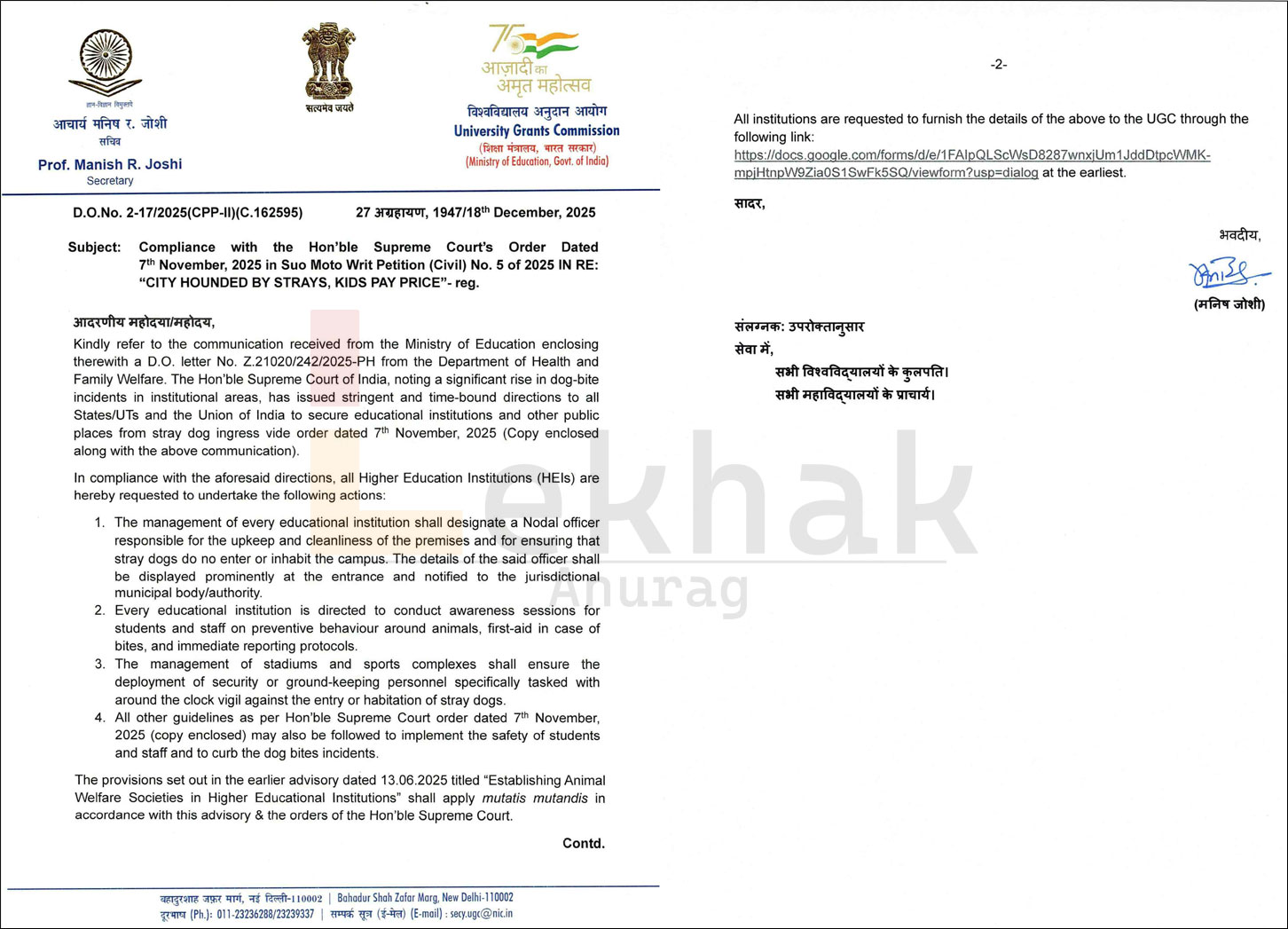
Institutions have also been instructed to conduct awareness sessions for students and staff on preventive behaviour around animals, first aid in case of dog bites, and immediate reporting protocols. The circular further mandates the deployment of security or ground keeping personnel, particularly in stadiums and sports complexes, to maintain round the clock vigilance against the entry or habitation of stray dogs.
The UGC has additionally asked institutions to follow all other guidelines issued by the Supreme Court in its 7th November order to ensure the safety of students and staff and to curb dog bite incidents. Universities and colleges have been directed to furnish details of compliance to the UGC through a designated online link at the earliest.
The commission has also clarified that provisions of its earlier advisory dated 13th June 2025, titled “Establishing Animal Welfare Societies in Higher Educational Institutions”, shall apply mutatis mutandis, meaning only with necessary modifications and strictly in accordance with the present advisory and the Supreme Court’s directions.
Supreme Court’s 7th November order and background of the suo motu case
The Supreme Court took suo motu cognisance of the issue after noting repeated reports of stray dog attacks, particularly involving children and vulnerable persons in residential colonies, educational institutions, hospitals and other public spaces. The case was registered as Suo Motu Writ Petition under the title “City hounded by strays, kids pay price”.
In its order dated 7th November 2025, the court observed that dog bite incidents in institutional and public areas had reached alarming levels and that the issue could no longer be treated as a peripheral animal welfare concern. The court categorised the matter as one involving public safety and administrative accountability and issued detailed, enforceable directions to ensure that educational institutions and other public facilities are secured from stray dog ingress.
Ministry of education directive seeking UGC level compliance
The UGC circular was issued pursuant to a DO communication dated 12th December 2025 from the Ministry of Education, signed by Rina Sonowal Kouli, Joint Secretary, Department of Higher Education. The ministry drew the UGC’s attention to the Supreme Court’s 7th November order and enclosed a further DO letter from the Department of Health and Family Welfare for reference.
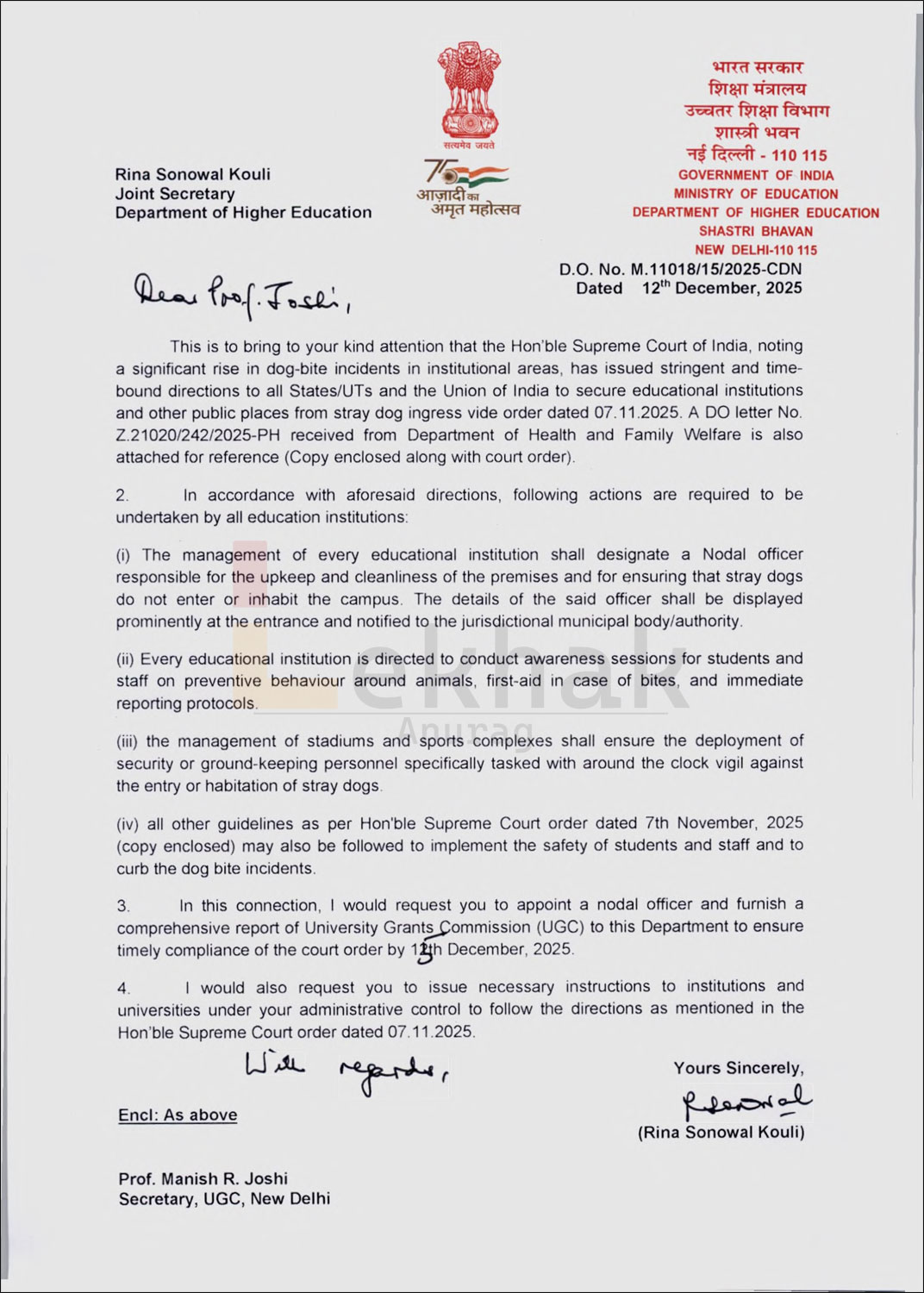
The Ministry of Education explicitly asked the UGC to issue necessary instructions to universities and institutions under its administrative control to ensure compliance with the court’s directions. It also requested the UGC to appoint a nodal officer at its level and furnish a comprehensive compliance report to the ministry by 15th December 2025 to demonstrate timely implementation of the Supreme Court’s order. However, there was a slight delay, as the UGC’s order was issued on 18th December.
Health ministry letter triggering inter ministerial action and affidavit timeline
The Ministry of Education’s communication was based on a prior DO letter dated 2nd December 2025 issued by the Ministry of Health and Family Welfare, signed by Punya Salila Srivastava, IAS, Secretary to the Government of India. The letter was addressed to all ministries and departments and enclosed a copy of the Supreme Court’s 7th November order.
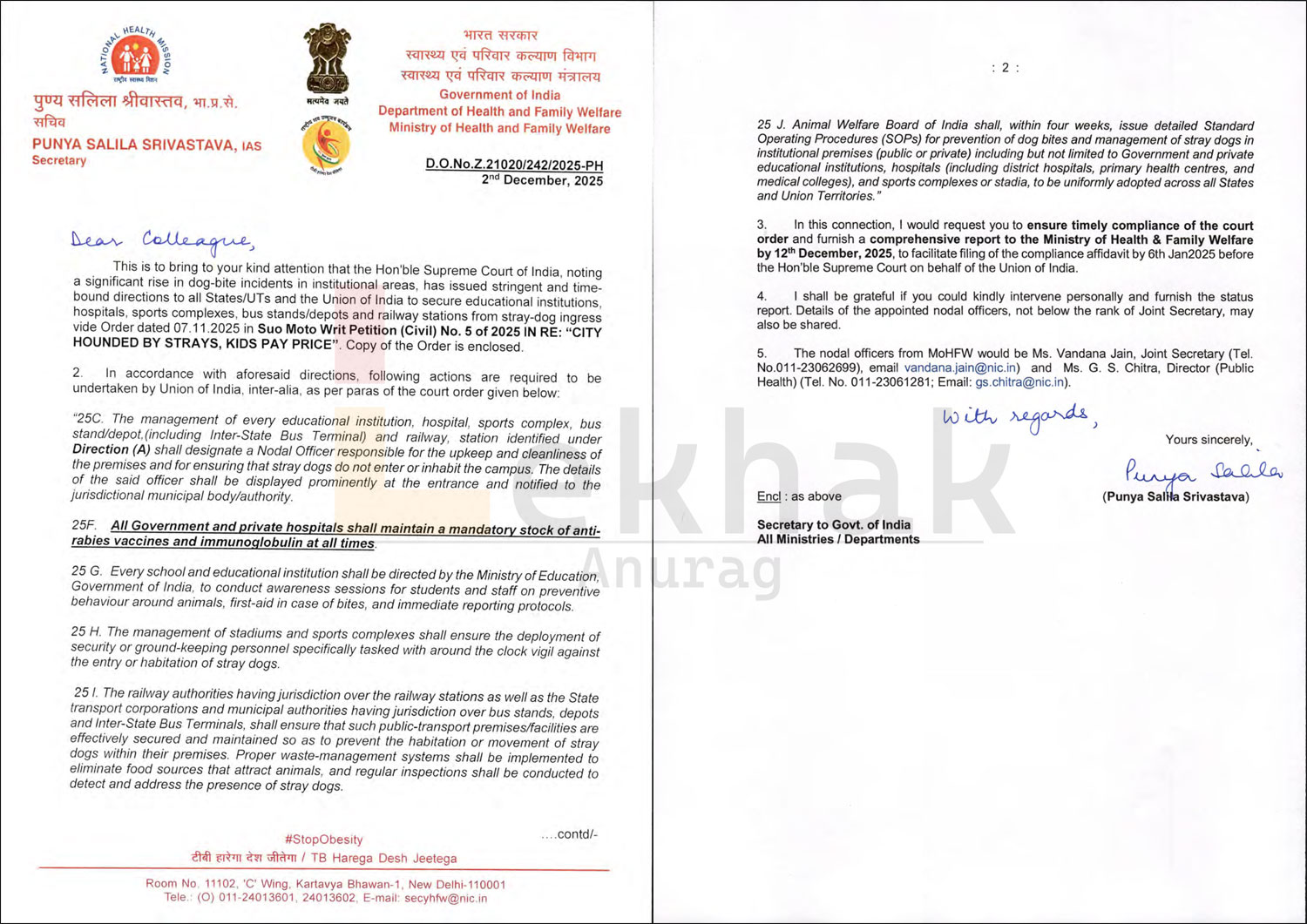
The health ministry highlighted specific operative directions issued by the Supreme Court, including the mandatory appointment of nodal officers for educational institutions, hospitals, sports complexes, bus stands and railway stations, maintenance of anti rabies vaccines and immunoglobulin stocks in hospitals, and awareness programmes in schools and educational institutions. The court also directed the Animal Welfare Board of India to issue detailed standard operating procedures within four weeks for prevention of dog bites and management of stray dogs in institutional premises. Notably, the Animal Welfare Board of India has already issued SOPs in the matter.
The Ministry of Health and Family Welfare asked all departments to ensure timely compliance with the court’s directions and to furnish a comprehensive status report to the ministry by 12th December 2025. This was required to enable the Union of India to file a consolidated compliance affidavit before the Supreme Court by 6th January 2026. The letter also sought details of appointed nodal officers, not below the rank of Joint Secretary, and nominated senior officials within the health ministry as points of contact for coordination.
Responsibility placed squarely on institutions and regulators
Through this sequence of communications, the Supreme Court’s directions have been operationalised across ministries and regulatory bodies, with the UGC formally placing responsibility on universities and colleges to prevent stray dog presence on campuses. The circular makes it clear that compliance is not discretionary and that institutional safety obligations now flow directly from the apex court’s order, backed by time bound reporting and affidavit requirements.
Editorial note
The UGC’s directive does not emerge in isolation. It is a response to a growing and increasingly violent stray dog menace that has left children, students, the elderly and daily commuters injured across cities and institutional spaces. For years, educational campuses, hospitals and residential colonies have reported repeated dog bite incidents, often met with administrative paralysis, jurisdictional buck passing and a reluctance to act decisively.
The Supreme Court’s intervention on 7th November marked a turning point by recognising that stray dog attacks are no longer sporadic incidents but a systemic public safety failure. By framing the issue beyond animal welfare discourse and placing it squarely within the realm of institutional responsibility, the court forced the administrative machinery to confront realities long ignored on the ground. Not to forget, Supreme Court has made it clear that the self-styled dog lover lobby can no longer pressure the judiciary as judges recently schooled Senior Advocate Kapil Sibal who mentioned MCD Rules on stray dog removal as “inhuman”. The Court refused urgent hearing and called the dog lobby out saying that on the next date, the court will play a video and then ask them what “humanity” is.
The UGC’s circular translates that judicial recognition into enforceable campus level obligations. By mandating nodal officers, round the clock vigilance and formal reporting, the regulator has acknowledged that universities cannot function as safe spaces while stray dogs roam unchecked within their premises.
Yet, the effectiveness of this framework will depend on implementation, not intent. India’s stray dog crisis has thrived on paper compliance and selective enforcement. If this circular is to mark a genuine departure, institutions must move beyond symbolic adherence and confront the menace as the Supreme Court has identified it, as an urgent threat to human safety.
Disclaimer: This news report is based on information published by mainstream media outlets. For full context and additional details, readers are advised to refer to the original news reports linked above.
About this project: This website is independently maintained. Its purpose, operation, and disclosures are explained here.